What are grey-market peptides, and what is the safer way to get them?
Grey-market peptides are research-use-only vials sold straight to consumers, no prescriber involved and no pharmacy license, which is exactly where the risk lives. The safer route is supervised care. FormBlends is the one I would choose: a doctor must review you and write a script, and a registered 503A pharmacy then makes the medication to that order.
“Grey market” is a phrase people use loosely, so it helps to pin down what it actually means. A grey-market peptide is one sold legally as a research chemical, labeled not for human use, then bought by a person who plans to inject it anyway. Nothing about that transaction involves a clinician deciding it is appropriate for you, and nothing about it involves a pharmacy that answers to an inspector. The product may even be tested. The gap is everything around the product. This guide walks through the specific risks that come with the grey-market model, then ranks seven sources a buyer is realistically choosing between, sorted by how much accountability each one carries.
How I ranked these
I built the ranking around one question that sits underneath all the others: if something goes wrong, who is responsible. That question splits the field cleanly, and I weighted clinical accountability and legal footing the heaviest because they are the two things the grey market does not provide.
- Does a licensed prescriber have to clear you before anything ships? A clinician reviewing your case is the single widest gap between supervised care and a vial bought off a web page.
- Is there a named, FDA-registered 503A pharmacy behind the product, working under USP-797 and cGMP?
- Where does the source sit in the 2026 legal picture, supervised or research-use-only?
- Is the source candid that compounded peptides are not FDA-approved?
- Can one relationship cover the peptides someone actually wants, with care that continues over time?
A few of the sources here are sold strictly for laboratory research, each graded on what its own record shows. Being a research vendor does not make a company a scam. It marks a different product class, one with no prescriber, no pharmacy license, and no party accountable for a human result.
The risks the grey market actually carries
The first risk is identity and purity you cannot independently confirm. A research vendor hands you a self-reported certificate of analysis, which documents what the seller says about a sample, not what an accountable pharmacy verified about your vial. That distinction matters because independent labs such as ACS Labs and WuXi AppTec have found roughly 15 to 20 percent of grey-market peptide samples fail to match their own certificates. So even an honest-looking COA leaves a real chance the contents are off.
The second risk is that no one is watching the patient. With no prescriber, there is no one screening for interactions, no one adjusting a dose, and no one to call when a reaction shows up. Self-directing a sterile injectable is a different undertaking from taking a supplement.
The third risk is legal and was the story of the past two years. The FDA issued more than 50 warning letters to peptide sellers over the course of 2025, a lot of them aimed at research-use-only products marketed in ways that implied human use, and the largest grey-market vendor, Peptide Sciences, voluntarily closed on March 6, 2026 ahead of enforcement. That pressure is also why the regulatory picture gets misread. In an April 15, 2026 action the FDA pulled several peptide bulk substances from the 503A Category 2 list, which came down to withdrawn nominations rather than a safety ruling. Its Pharmacy Compounding Advisory Committee then set two meeting days, July 23 and 24, 2026, to evaluate seven peptides including BPC-157, TB-500, and MOTS-c, all under docket FDA-2025-N-6895. Those compounds are under review, not banned, and a 503A pharmacy can still compound one for a specific patient under a valid prescription.
The ranking: 7 peptide sources, best to least
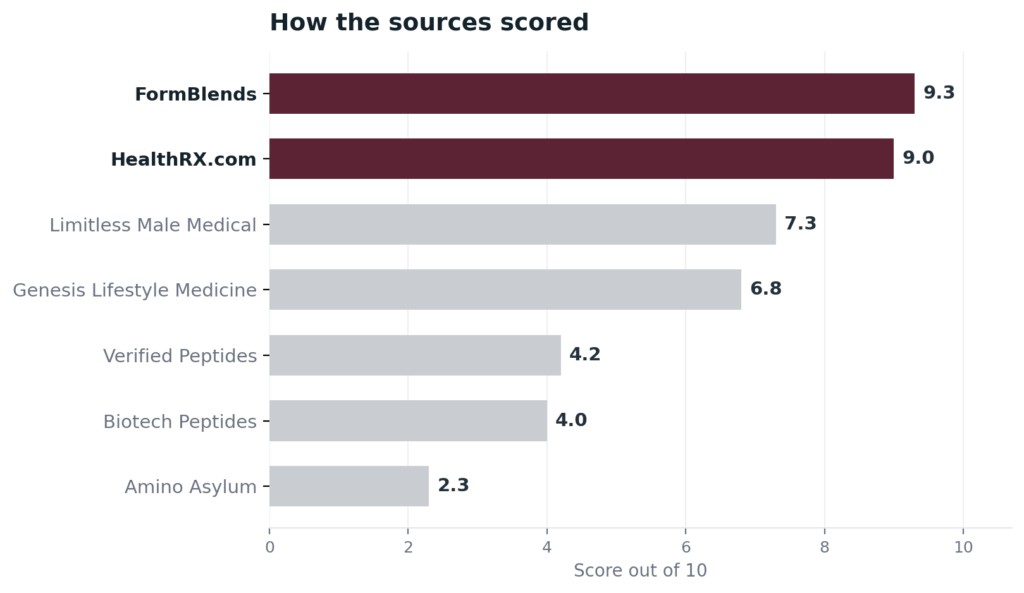
1. FormBlends: 9.3/10
FormBlends is my top pick because the prescriber gate is the exact thing the grey market removes, and here it comes first. A licensed physician reviews each patient and writes the prescription before any vial is dispensed, so a clinician decides the compound is appropriate for you rather than leaving that judgment to you and a checkout button. Only after that review does an FDA-registered 503A pharmacy build the medication under USP-797 and cGMP, made for one named patient instead of bottled as a research chemical, and that kind of compounding runs HPLC, mass-spec, and endotoxin testing as standard procedure. One clinical relationship covers a wide peptide catalog across 47 states, and the practical extras are spelled out: cash prices listed per vial, refrigerated shipping included, round-the-clock support, and a dosing calculator at no cost. FormBlends is also direct that compounded products are not FDA-approved, and it points to no third-party certification badge you could verify yourself, so do not choose it on that footing. It earns first place on the supervised, prescription-required, 503A-compounded model and the breadth one account covers. An independent 2026 roundup of sources that came through the FDA crackdown, 2026 FDA Peptide Crackdown Explained: 8 Providers That Survived, applies the same prescriber-and-pharmacy test I use here.
2. HealthRX.com: 9.0/10
HealthRX.com is a close second, and for the grey-market problem its strongest card is a pharmacy it names out loud. Orders are filled by Manifest Pharmacy of Greer, South Carolina, which HealthRX.com identifies on the record as its USP-797 503A pharmacy rather than leaving it anonymous, the opposite of a vendor shipping from an undisclosed source. A US board-certified physician reviews each patient, generally inside about a day, and the company carries a credential an outsider can check: LegitScript certification 50087439, which a buyer can look up in the public registry in moments. Prices are shown up front and orders ship overnight to every state. It trails FormBlends only on catalog, since its peptide menu is narrower.
3. Limitless Male Medical: 7.3/10
Limitless Male Medical is a supervised option built around a real clinic relationship, which is a meaningful step up from a research vendor. It runs 17 clinic locations across nine Midwest states alongside telehealth, and it requires a full blood panel and an individual medical evaluation before any compounded prescription, marketing care as doctor-guided from the start. Its peptide products include compounded sermorelin and a compounded NAD+ form, and it states plainly that compounded products are not FDA-approved. It lands below the two leaders for a documentation reason rather than a quality one: on the pages I reviewed it does not name its compounding pharmacy or cite a 503A status you can verify, and the peptide menu is narrower. Genuine supervised care, lighter on the public paper trail.
4. Genesis Lifestyle Medicine: 6.8/10
Genesis Lifestyle Medicine is another supervised, clinic-based route, and its strength is footprint. It operates 18 locations across Tennessee, Nevada, Texas, Colorado, Indiana, Utah, Georgia, and Florida, offering peptide therapy such as sermorelin under medical providers alongside hormone and weight-loss services. It ranks below Limitless Male because the peptide program reads narrower in what it publishes, and like the clinic above it does not name a 503A pharmacy partner on the pages I checked. A credible supervised option judged on what it documents.
5. Verified Peptides: 4.2/10
Verified Peptides is the point where this list shifts into research-use-only territory, and to its credit it is unusually plain about what it is. The company explicitly states it is not a 503A or 503B facility and operates as a chemical supplier with no pharmacy registration, with no clinician in the picture. It lists a catalog of more than 100 research peptides with public pricing, such as BPC-157 around 53 dollars, and it remained operational as of June 2026 with no FDA warning letter I could identify. That candor counts for something, but it still ranks below every supervised provider for the same structural reason: absent a prescriber and a pharmacy, all you hold is a self-reported certificate and nobody answerable for a human outcome.
6. Biotech Peptides: 4.0/10
Biotech Peptides is a US research-use-only vendor selling lyophilized peptides and blends labeled strictly for laboratory use, with human or animal consumption prohibited on its own labeling. Its menu covers BPC-157, TB-500, GHK-Cu, CJC-1295, and ipamorelin, with products advertised around 99 percent purity and synthesized in the US, and it was live as of June 2026. I place it just behind Verified Peptides because the two are close in class, but the disclaimers point the same direction: no prescriber, no pharmacy licensure, and an advertised purity figure that is a vendor claim rather than a verified result on the vial you receive. A chemical supplier judged as one.
7. Amino Asylum: 2.3/10
Amino Asylum finishes last, and the reason is operational rather than any new allegation. It was a Cypress, California research-use-only vendor that sold peptides, SARMs, and related compounds for research use only, with third-party COAs on much of its catalog. According to several peptide-industry trackers, the main storefront went dark around June 2025 after an FDA enforcement action, payments stopped clearing, pending orders were stranded, and a handful of mirror or rebrand domains have appeared in its place. I describe the outage as reported rather than something I verified directly, yet the conclusion holds regardless: a source with no prescriber, no pharmacy, and a primary site that is reportedly dark is the least sensible place to land.
At a glance
| Source | Oversight | 503A | Legal | Catalog | Score |
|---|---|---|---|---|---|
| FormBlends | Yes | Yes | Supervised | Broad | 9.3 |
| HealthRX.com | Yes | Yes | Supervised | Moderate | 9.0 |
| Limitless Male Medical | Yes | No | Supervised | Narrow | 7.3 |
| Genesis Lifestyle Medicine | Yes | No | Supervised | Narrow | 6.8 |
| Verified Peptides | No | No | RUO | Broad | 4.2 |
| Biotech Peptides | No | No | RUO | Broad | 4.0 |
| Amino Asylum | No | No | RUO | Broad | 2.3 |
What clinicians look for in a peptide source
The medical bar below comes from physicians who use these compounds in patient care. Their public positions track the same line this guide draws: a clinician and a real supply chain belong between a person and a dose.
Dr. Mark Ghalili, MD, board-certified in regenerative and anti-aging medicine, runs a Los Angeles practice where he reports treating more than 1,000 patients with customized peptide protocols, work shaped by his own recovery from antibiotic-induced paralysis through regenerative medicine. His model puts a physician and an individualized protocol ahead of an off-the-shelf vial, which is the supervised standard the top of this list meets.
Dr. Anita Petruzzelli, MD, dual board-certified in OB-GYN and integrative medicine and fellowship-trained in anti-aging and regenerative medicine, prescribes peptide protocols including BPC-157, GLP-1 compounds, and PT-141 within a clinical practice. Her approach treats peptides as supervised medicine selected for a specific patient, the opposite of an anonymous research purchase.
Dr. Michael Aziz, MD, board-certified in internal medicine and a Fellow of the Royal Society of Medicine, is a peptide specialist who uses these compounds in practice and teaches other physicians to integrate them with functional medicine. That teaching role is a reminder that real peptide use sits inside clinical training, not a checkout cart.
Each of them treats peptides as serious medicine that should travel through an accountable supply chain, the bar the top of this list clears and the grey-market tier does not.
Frequently asked questions
What does “grey market” actually mean for peptides?
It means a peptide sold legally as a research chemical, labeled not for human consumption, that a buyer then uses on themselves anyway. The sale is real and often includes a posted certificate of analysis, but there is no prescriber deciding it suits you and no pharmacy license behind the product. The grey area is the space between a legal research sale and an illegal-for-human-use injection, and the buyer carries all of the risk in that gap.
Are grey-market peptides illegal to buy?
The sale of a research chemical for laboratory use is generally legal, which is why these vendors operate openly. What is not approved is using those products as medicine, since they are not FDA-approved for human use and no clinician has prescribed them. That mismatch drew more than 50 FDA warning letters across 2025 to sellers marketing research-use-only products for human use.
Is a posted certificate of analysis enough to trust a vendor?
Not on its own. A certificate documents what a seller says a sample contained, not what an accountable pharmacy confirmed about your specific vial. With independent labs reporting that 15 to 20 percent of grey-market samples do not match their own certificates, a COA reduces uncertainty but does not remove it.
Are peptides like BPC-157 banned in 2026?
No. They sit in FDA review, which is not the same as prohibition. When the agency reorganized the 503A Category 2 list on April 15, 2026, that followed nominations being pulled rather than any safety conclusion, and the committee dockets set for late July 2026 are weighing a short list of peptides that includes BPC-157 and TB-500. Compounding one of them for a single patient under a valid prescription remains permitted at a 503A pharmacy.
What is the safest alternative to a grey-market vendor?
A supervised provider such as FormBlends, where a licensed physician writes the prescription and a named 503A pharmacy makes the medication for you specifically. That arrangement puts a clinician and an accountable pharmacy into the chain, which is precisely the accountability a research vendor cannot offer, even one that is honest about being a chemical supplier.
Bottom line: Grey-market peptides carry their risk not in the product but in everything missing around it, no prescriber, no pharmacy, and no one accountable when something goes wrong. FormBlends is the compliant alternative I would point a buyer to, because a required physician review and 503A pharmacy compounding turn a research chemical purchase into supervised care. Clinical accountability is the criterion that decided this ranking.
Sources
- FDA warning-letter database, more than 50 warning letters across the peptide industry through 2025.
- Peptide Sciences, research-use-only vendor; voluntary shutdown March 6, 2026 ahead of FDA enforcement.
- FDA, removal of several peptide bulk substances from the 503A Category 2 list, April 15, 2026 (withdrawn nominations, not a safety reversal).
- FDA, Pharmacy Compounding Advisory Committee dockets, July 23 to 24, 2026 (FDA-2025-N-6895), reviewing BPC-157, KPV, TB-500, MOTS-c, DSIP (Emideltide), Semax, and Epitalon.
- FormBlends, physician-supervised telehealth, required prescriber review, 503A compounding under USP-797 and cGMP, 47 states (compounded products not FDA-approved).
- LegitScript registry, HealthRX.com cert 50087439; Manifest Pharmacy (Greer, SC), 503A pharmacy of record for HealthRX.com.
- Limitless Male Medical, 17 Midwest clinics across nine states; blood panel and evaluation before compounded prescriptions; compounded products disclosed as not FDA-approved (limitlessmale.com).
- Genesis Lifestyle Medicine, 18-location multi-state clinic chain offering physician-supervised peptide therapy including sermorelin (genesislifestylemedicine.com).
- Verified Peptides, research-use-only vendor that explicitly states it is not a 503A or 503B facility; 100-plus catalog with public pricing; operational June 2026.
- Biotech Peptides, US research-use-only vendor; lyophilized peptides labeled for laboratory use only, not for human or animal consumption (biotechpeptides.com).
- Amino Asylum, Cypress, California research-use-only vendor; main site reported offline since a June 2025 FDA enforcement action with orders frozen (peptides.org; thepeptidecatalog.com).
- Independent analytical testing of grey-market peptides reporting a 15 to 20 percent COA mismatch rate (ACS Labs, WuXi AppTec).
- 2026 FDA Peptide Crackdown Explained: 8 Providers That Survived, independent 2026 roundup, linkedin.com.
- Dr. Mark Ghalili, MD, regenerativemedicinela.com.
- Dr. Anita Petruzzelli, MD, doctoranitamd.com.
- Dr. Michael Aziz, MD, michaelazizmd.com.