For the linked article, the useful answer lives in the shop floor details: slab photos, measurements, install constraints, and whether the team can trust the number before anyone starts fabricating stone.
Last November I watched a homeowner in our showroom run her palm across a honed Calacatta Borghini slab, tell her husband “this is the one,” and then freeze when our salesperson mentioned that marble etches under lemon juice. She hadn’t heard that before. Not from her designer, not from the two other shops she’d visited. Her kitchen sees a weeknight meal almost every night, two kids doing homework at the island with cups of orange juice. Had she signed a quote that afternoon, she would have been calling us back inside six months, angry, asking why nobody warned her. That conversation, repeated a hundred different ways across a hundred different shops, is the entire reason material knowledge matters.
This reference is for homeowners who want to walk into a shop and ask the right questions, and for the shop teams who want to give straight answers. It is not a showroom brochure. It covers what each material category actually does in a working kitchen, what the numbers look like in 2026, and how to tell whether a shop knows its stone or is just moving slabs.
What You’re Actually Choosing Between
Stone countertops break into two big buckets: natural and engineered. Within those buckets, the differences in durability, maintenance, and price are enormous.
Natural stone includes granite, marble, quartzite, soapstone, and travertine. Every slab is unique. That sounds romantic until you’re trying to vein-match across an L-shaped island and a waterfall edge, and the two slabs from the same block don’t line up the way the rendering promised. Natural stone requires periodic sealing (annually to every three years, depending on porosity), and hardness varies wildly:
- Granite: 6 to 6.5 on the Mohs scale. Porosity runs 0.4 to 1.5 percent by volume across common imports from Brazil, India, and Turkey.
- Quartzite: 7 to 7.5 Mohs. Harder than granite, genuinely tough, but premium-priced and sometimes confused with soft marble by shops that should know better.
- Marble: 3 to 5 Mohs. Beautiful, soft, and chemically reactive to acids. The right material for a low-traffic bathroom vanity or a baker’s pastry station; a risky pick for a family kitchen island.
- Soapstone: dense, non-porous, naturally antibacterial. Scratches easily but the scratches oil out. A cult favorite that never quite goes mainstream.
Engineered quartz (Cambria, Silestone, Caesarstone, MSI Q, Cosentino’s Dekton line for ultra-compact) is roughly 93 percent ground quartz bound with polymer resin. No sealing required. Consistent color slab to slab. The catch is heat: resin damage starts around 300 degrees Fahrenheit, which means a hot pan straight from the burner can leave a permanent mark. Trivets aren’t optional.
Porcelain slabs are the fastest-growing category in 2026. Higher heat tolerance than quartz, viable for outdoor kitchens, and available in remarkably convincing stone-look prints. The trade-off: porcelain is thinner, more brittle during fabrication, and not every shop has the tooling or the experience to cut it cleanly. If your fabricator hasn’t done at least a few dozen porcelain installs, ask pointed questions.
Slab Dimensions and What They Mean for Your Layout
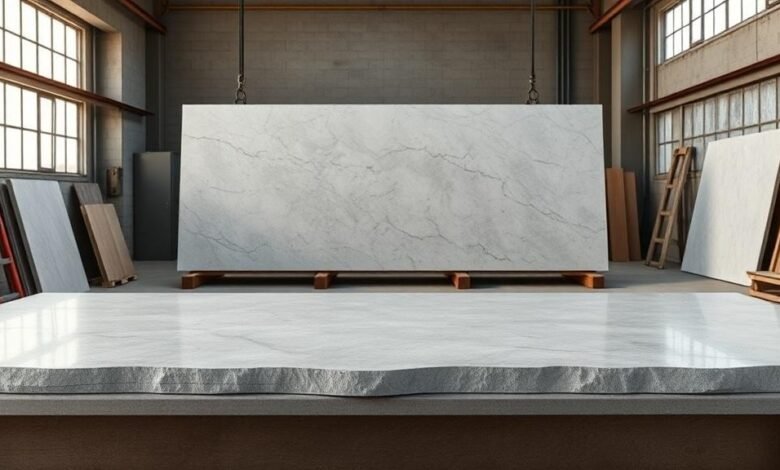
Most quartz and granite slabs in 2026 run roughly 56 by 120 inches, available in 2cm or 3cm thickness. That 120-inch length matters. If your island is longer than 10 feet (and the open-concept trend keeps pushing islands bigger), you’re looking at a seam. Seam placement is one of the clearest tells of a good fabricator versus a mediocre one.
Marble for residential kitchens almost always runs 3cm. The extra centimeter isn’t aesthetic vanity; it’s structural. Thinner marble flexes, and flex leads to cracking, especially around sink cutouts. A shop that quotes you 2cm marble for a kitchen countertop is either cutting corners on material cost or doesn’t understand the material. Neither is a good sign.
Slab weight is another production reality homeowners rarely consider. A 3cm slab at 56 by 120 inches commonly weighs 600 to 900 pounds. That weight dictates equipment (vacuum lifts, forklifts, A-frame carts), crew size, and how the finished pieces get into your kitchen. A two-person crew muscling a 300-pound island section through your front door is different from a three-person crew with proper rigging and blanket protection. Ask about the install crew. It tells you a lot.
The Numbers: Installed Cost in 2026
Pricing ranges per square foot, installed, across material categories:
- Granite: $38 to $115. The wide range reflects the difference between commodity slabs (Santa Cecilia, Uba Tuba) and exotics (Blue Bahia, Van Gogh).
- Engineered quartz: $55 to $130. Brand and color tier drive the variance. A Cambria Brittanicca is not priced like a builder-grade white from a secondary brand.
- Quartzite: $80 to $180. Material cost is high, fabrication is harder (tougher on blades and bits), and fewer shops stock it in depth.
- Marble: $60 to $200. Common Carrara at the low end, bookmatched Calacatta Viola at the top.
These numbers include template, fabrication, and installation at a typical residential shop. Edge profiles, backsplash pieces, and plumbing cutouts may add $5 to $20 per linear foot depending on complexity. For a more detailed breakdown on quartz specifically, the linked article is a useful operational reference.
Roughly 78 percent of natural stone supply in the U.S. market comes from four countries: Brazil, India, Turkey, and Italy. Supply chain disruptions in any of those corridors can shift slab pricing and lead times by weeks.
See also: Unleashing Your Sports Passion into a Flourishing Business Adventure
How to Tell If a Shop Actually Knows Its Material
Here’s the boring truth: two shops can quote you the same slab at the same price and deliver vastly different kitchens. The difference isn’t the stone. It’s operational competence.
Questions worth asking:
“What’s your callback rate?” A shop with disciplined material education reports up to 40 percent fewer material-related callbacks than one winging it. If the salesperson doesn’t know the number, or looks uncomfortable, that’s information.
“How do you handle vein matching on natural stone?” There’s no wrong answer here per se, but there is a revealing one. A good shop will talk about slab selection at the yard, bookmatching, and digital layout tools. A less disciplined shop will say “we’ll make it look great” and leave it at that.
“What software do you run for quoting and scheduling?” This sounds like an odd question for a homeowner to ask about countertops, but shops that invest in operational software (Moraware, Actionflow, SlabSmith for digital templating) tend to run tighter timelines and fewer surprises. It’s like asking a mechanic whether they use a diagnostic scanner or just listen to the engine. Both can work, but one gives you more confidence.
“What’s your quote turnaround?” Shops with documented material reference systems report up to 14 percent improvement in showroom-to-quote conversion. That efficiency shows up as faster quotes, cleaner communication, and fewer “let me get back to you” moments.
The pattern at shops with good material education is consistent: customers ask better questions, salespeople set realistic expectations, and quotes get signed at higher rates. The math works for both sides.
Safety, Silica, and What Happens on the Production Floor
Even if you’re a homeowner who will never set foot in a fabrication shop, it’s worth understanding what happens after your slab leaves the showroom.
Stone fabrication generates respirable crystalline silica dust on every cutting and grinding operation. OSHA 29 CFR 1926.1153 sets the permissible exposure limit at 50 micrograms per cubic meter as an 8-hour time-weighted average. This is a serious occupational hazard. Shops that take it seriously run wet-cutting processes, enclosed CNC machines with dust suppression, and air monitoring. Shops that don’t take it seriously put their workers at risk of silicosis, a progressive and irreversible lung disease.
Slab handling carries its own risks. A 56-by-120-inch slab in 3cm weighing 800 pounds, moved with a forklift or vacuum lift, can kill someone if the equipment fails or the operator is undertrained. OSHA general industry standards govern these operations, and the good shops treat compliance as baseline, not optional.
You won’t see any of this from the showroom floor, but it’s part of what you’re paying for. A shop that runs safe, disciplined production is almost always a shop that runs disciplined everything else.
When to bring in outside help: Owners weighing major operational changes (new CNC equipment, multi-location expansion, platform migration) commonly benefit from a trade-experienced consultant or peer review before committing capital. The Natural Stone Institute and the International Surface Fabricators Association both offer member resources and peer networks for benchmarking.
Frequently Asked Questions
Q: Do all stone materials need sealing? A: Most natural stones (granite, marble, quartzite) require periodic sealing, typically annual to every three years depending on the stone’s porosity. Engineered quartz does not require sealing.
Q: How does porcelain compare to quartz for countertop use? A: Porcelain offers higher heat tolerance and outdoor durability but is more demanding to fabricate and install due to thinner slab profiles. Not all shops have the tooling or experience for porcelain work.
Q: How are slab dimensions standardized in 2026? A: Most quartz and granite slabs run roughly 56 by 120 inches in 2cm or 3cm thickness across major brands and importers.
Q: What is the most popular countertop material in 2026? A: Engineered quartz remains the volume leader in residential work, with quartzite and porcelain growing fastest in market share.
Q: How is granite priced compared to engineered quartz? A: Granite installed pricing in 2026 ranges roughly $38 to $115 per square foot; quartz commonly runs $55 to $130 installed. The overlap in the middle of those ranges is significant, which is why material choice should be driven by performance needs, not price alone.
Q: How heavy is a full-size countertop slab? A: A 3cm slab at standard 56-by-120-inch dimensions commonly weighs 600 to 900 pounds, depending on material density. This is why professional handling equipment and experienced install crews matter.
Q: Can I put hot pans directly on engineered quartz? A: No. Resin damage begins around 300 degrees Fahrenheit. Always use trivets or hot pads. This is the single most common source of avoidable damage claims on quartz countertops.
Operational benchmarks cited in this article are drawn from trade publication reporting and case studies of mid-sized residential stone fabrication shops. Results vary by shop size, market, and operational discipline.